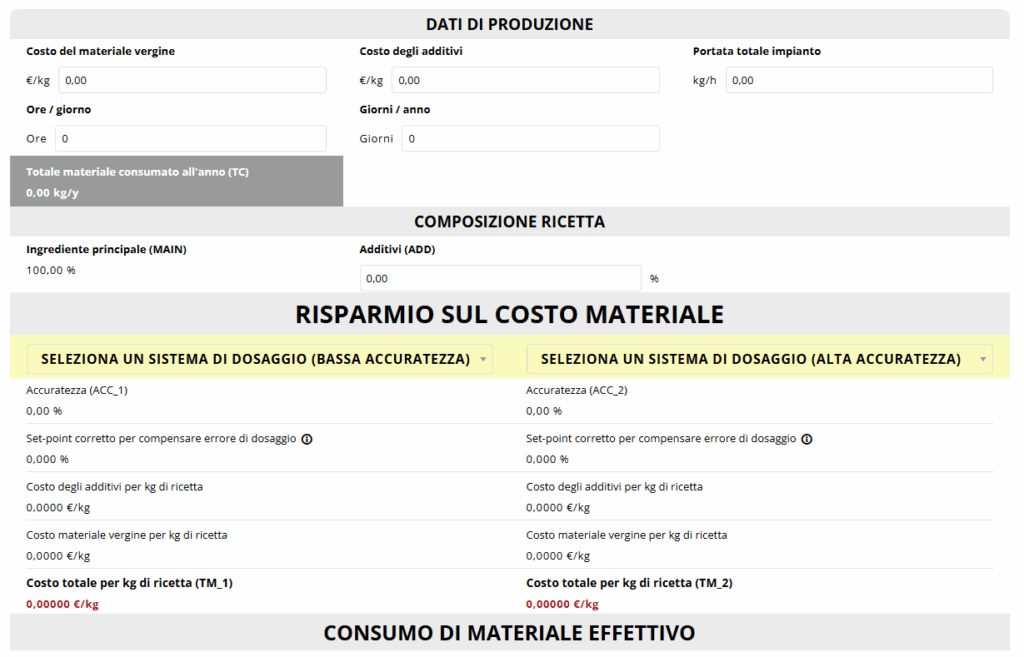
In gravimetric dosing systems, accuracy represents the deviation between the set value and the actual value delivered. Even when this deviation is small (for example ±1–2%), the impact on the annual consumption of additives can be significant, especially in high‑volume production lines using expensive materials. Choosing a more accurate dosing system therefore helps reduce unnecessary material consumption, but how much are we actually talking about? To answer this question, we have created a simple calculator that simulates two different accuracy levels and provides an indicative estimate of the potential savings.
WHY SUCH A SMALL ERROR CAN GENERATE A LARGE COST
Since a certain degree of variability in dosing is always present, operators tend to set a slightly higher set‑point to avoid the risk of under‑dosing, which could compromise product quality.
This slight over‑correction, even if minimal, results in an increase in the actual consumption of additives. Over the course of a year, the difference can become substantial.
CUMULATIVE EFFECT ON PRODUCTION
In a plant operating thousands of hours per year, even a 1.5% deviation can amount to hundreds of kilograms of additional material.
The cost of this extra material represents a “hidden cost” that is often not immediately perceived but has a direct impact on the system’s Total Cost of Ownership (for more details on the Total Cost of Ownership, click here).
ACCURACY AND SAVINGS
At this point, the question is: how much can you actually save by choosing a more accurate dosing system?
The simulation allows you to compare two accuracy levels and estimate, in an indicative way, the impact on material consumption. While it is not a rigorous calculation model, it provides a useful ballpark estimate of the potential savings and the resulting effect on material costs when opting for a more precise feeder.